← All posts
Strategy
Marketing budget allocation: the 60/30/10 default
A sensible starting split for £1M–£10M annual budgets.
Maya Lin · 11 May 2026
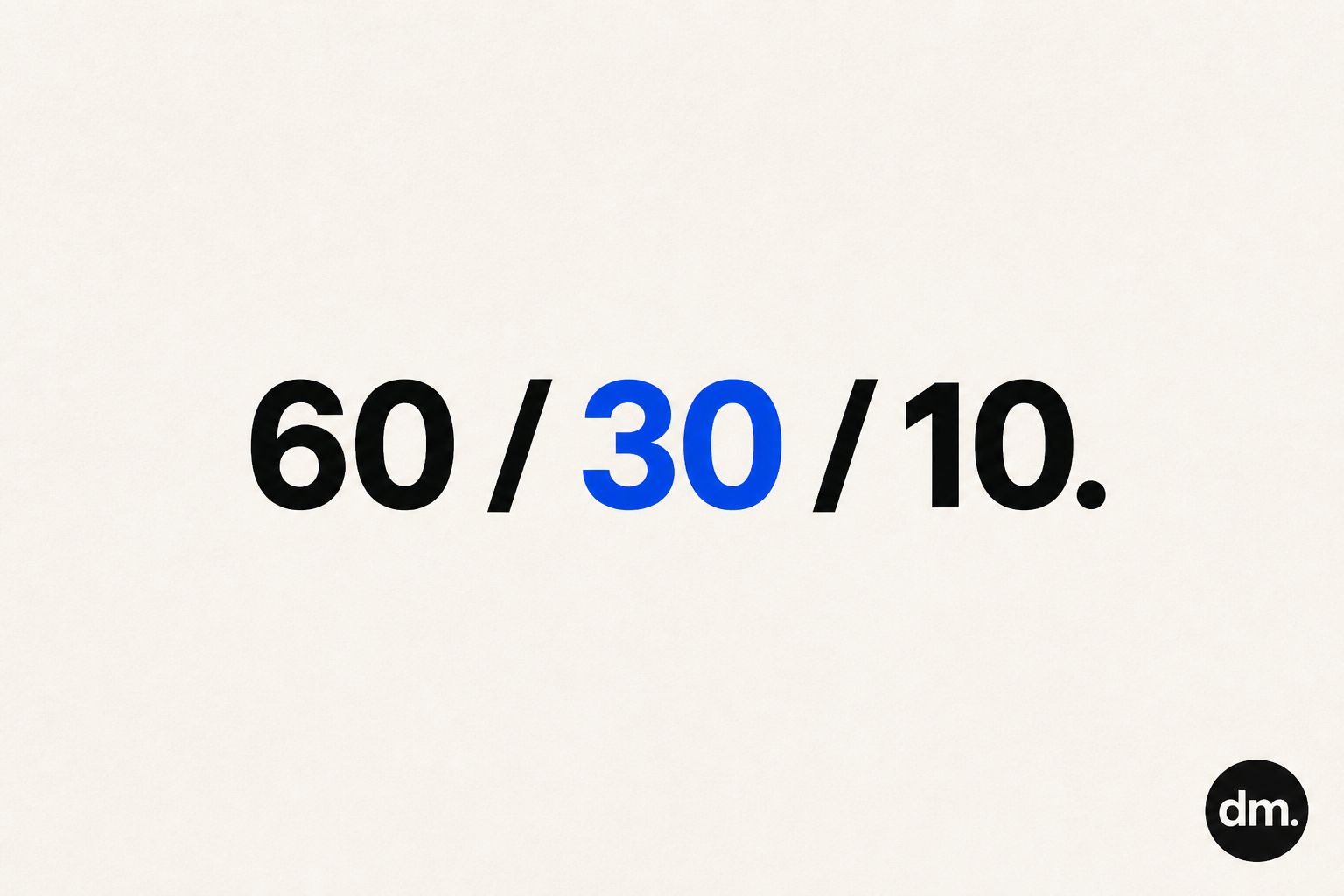
Budget allocation is where most plans go wrong because the defaults are inherited, not derived. Start from a known split, then adjust on evidence. The 60/30/10 default below isn't optimal for every brand — but it's a defensible starting point that won't bankrupt you while you learn what your actual mix should be.
The 60/30/10 split
- 60% — proven performance channels with reliable attribution (paid search, retargeting, mature paid social).
- 30% — scaling experiments where signal is real but uncertainty is still meaningful (new channels, new audiences, new creative formats).
- 10% — genuine brand bets with long-payback measurement (above-the-line, podcast sponsorship, sponsored content, community).
The reallocation cadence
Quarterly, against MMM and incrementality results. Resist intra-quarter reshuffles unless a channel collapses. The teams that reallocate monthly chase noise; the teams that reallocate annually miss inflection points.
When to deviate
- Brands under 18 months old should weight toward 75/25/0 — survival before brand.
- Established brands with strong product-market fit can push to 50/30/20.
- Category-creating brands need 40/30/30 because category education is brand spend.
- Holiday/seasonal brands should shift 5–10% from brand to performance in peak.
What kills the split
Quarterly board pressure to 'show results' usually compresses the 30% experiment bucket. Defend it; without it, you have no pipeline of next year's 60%.