Local SEO for estate agents: the 2026 guide to Google Business Profile and map pack rankings
A comprehensive playbook for estate agents who want to dominate the local map pack, optimise their Google Business Profile, and turn 'estate agents near me' searches into instructions.
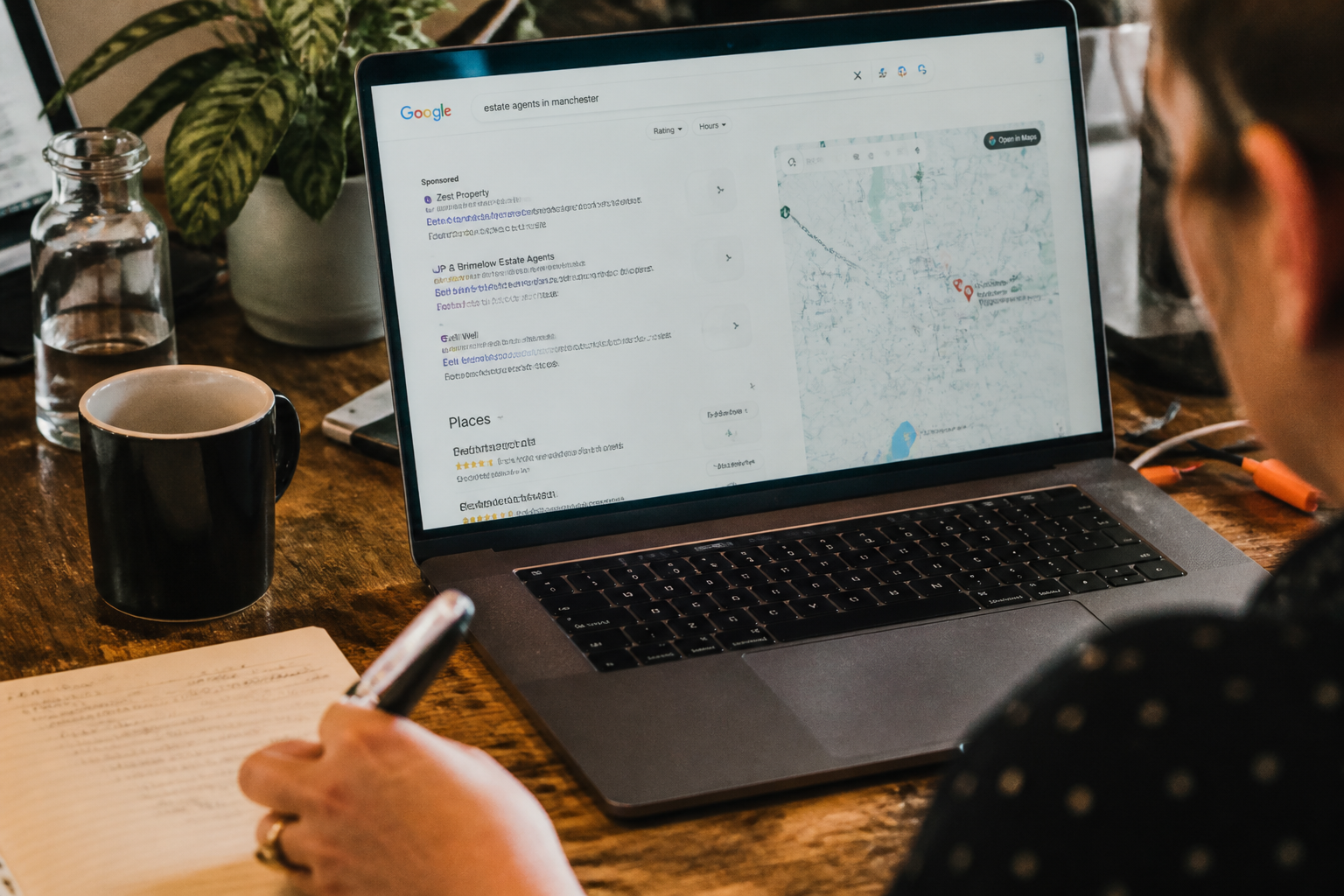
If you're an estate agent and you're not visible in the local map pack, you're invisible to most sellers and landlords in your patch. 'Estate agents near me' and '[town] estate agents' searches almost always trigger Google's three-pack — and the agents that show up there capture the lion's share of high-intent traffic before a single organic blue link is clicked. This guide walks through everything we do for our estate agent clients to win local SEO: Google Business Profile optimisation, on-site signals, citations, reviews, and the local content strategy that ties it all together.
Why local SEO matters more than ever for estate agents
Google's local map pack sits at the very top of the results page for the searches that matter most to estate agents: 'estate agents in [town]', 'letting agents near me', '[area] property valuation'. Map pack listings get clicked far more often than position one organic — they're visual, they show ratings, and they include a phone number and directions. For agents competing against the corporates and the portals, local SEO is the most cost-effective way to win share of voice in your branch's catchment.
Google Business Profile: the foundation
Your Google Business Profile (GBP) is the single most important asset in local SEO. Get the basics right before anything else.
GBP optimisation checklist
- Claim and verify every branch separately — one profile per physical office, not one profile for the brand.
- Use your exact registered business name. Don't keyword-stuff (e.g. 'Smith & Co Estate Agents Tunbridge Wells') — Google can suspend you for it.
- Pick the most specific primary category: 'Estate agents' or 'Real estate agency'. Add secondary categories like 'Letting agents', 'Property management company', 'Commercial real estate agency' where relevant.
- Write a 750-character business description that names the towns and postcodes you cover, the services you offer (sales, lettings, valuations, land), and what makes you different.
- Add high-quality photos: exterior of the branch, interior, the team, and recently sold or let properties. Aim for 20+ and refresh monthly.
- Set accurate opening hours including bank holidays — Google penalises profiles with stale hours.
- Add every service you offer as a Service item with its own description (Sales valuation, Lettings valuation, Property management, Land and new homes, etc.).
- Turn on messaging and respond within 24 hours — response rate is a ranking factor.
- Post weekly GBP updates: new instructions, just sold, market commentary, open house events.
Map pack rankings: the three things Google ranks on
Google's local algorithm boils down to three signals: relevance (does this business match the search?), distance (how close is the searcher?), and prominence (how well-known and well-reviewed is this business?). You can't change distance — but you can move relevance and prominence.
On-site signals that move the local map pack
- A dedicated landing page for every branch with the branch name, full NAP (Name, Address, Phone) in text not just an image, and embedded Google Map.
- LocalBusiness schema markup on each branch page with address, geo coordinates, opening hours, and aggregate review rating.
- Town and area landing pages — one page per catchment area, written for buyers and sellers in that specific town. Don't duplicate; each page needs unique local content.
- Internal links from the homepage and branch pages to your area guides.
- Page speed under 2.5s LCP on mobile — Google's mobile-first index punishes slow branch pages hard.
Reviews: the prominence lever
Reviews are the single biggest prominence signal you can influence. Agents with 100+ recent reviews at 4.7+ stars routinely outrank corporates with bigger brand presence but stale review profiles. Build a simple, repeatable process: every completed sale, let, and valuation gets a personalised review request from the agent who handled it, sent within 24 hours of completion. Use a short link to your GBP review page — don't make clients hunt for it.
Responding to reviews
- Respond to every review — positive and negative — within 48 hours.
- Use the reviewer's name and reference something specific (the property, the area, the service).
- For negative reviews, acknowledge, apologise where appropriate, and move the conversation offline. Never get defensive in public.
- Mention your town and service in responses naturally — 'thanks for choosing us for your Tunbridge Wells letting' — this reinforces relevance signals.
Citations and NAP consistency
Citations are mentions of your business name, address, and phone number across the web. Inconsistent NAP — a different phone number on Yell, a typo in your address on Thomson Local, an old branch address on Yelp — confuses Google and suppresses your local rankings. Audit your citations quarterly and clean them up.
Priority citation sources for UK estate agents
- Yell, Yelp, Thomson Local, Bing Places, Apple Maps, Yahoo Local — the universal directories.
- OnTheMarket, Rightmove, Zoopla — portal profiles should mirror your GBP exactly.
- The Property Ombudsman, Propertymark, ARLA — industry body listings carry trust signals.
- Local chamber of commerce, BID, and town directory listings — high-relevance local signals.
- Local news sites and sponsorship pages where the agent is named with full NAP.
Local content strategy
The agents winning long-tail local search aren't the ones publishing generic 'how to sell your home' articles — they're publishing hyperlocal area guides, school catchment reports, and town market commentary. Every quarter, publish one in-depth area guide per branch. Pair it with a fresh market update covering local sold prices, stock levels, and demand trends. This is what makes you the authority Google trusts to rank for '[town] estate agents'.
Tracking what matters
Local SEO doesn't show up in Google Search Console the way organic does. Track GBP Insights weekly (searches, calls, direction requests, website clicks), use a tool like BrightLocal or Whitespark to track your map pack rankings for your priority terms by location, and tie GBP-sourced enquiries back to your CRM so you can prove ROI to the partners.
The 90-day local SEO sprint
- Weeks 1–2: Audit and fix every GBP. Standardise NAP across all citations.
- Weeks 3–4: Build or rewrite branch landing pages with schema, embedded maps, and unique local content.
- Weeks 5–8: Launch the review process — every completion triggers a request. Aim for 25+ new reviews in 8 weeks.
- Weeks 9–10: Publish two flagship area guides per branch covering market data, schools, lifestyle, and a 12-month price trend.
- Weeks 11–12: Measure map pack position movement, GBP enquiries, and branch-level lead volume. Double down on what moved the needle.
Where most agents go wrong
The pattern we see again and again: agents claim their GBP, fill in the basics, then never touch it again. Local SEO compounds with consistency — weekly posts, fresh photos, fast review responses, fresh content. Treat the GBP like a shop window: if it looks stale, sellers and landlords assume the business is too.
Want this done for you?
We run local SEO programmes for estate agents across the UK — GBP management, area guide content, review acquisition, and citation cleanup, all reported monthly against map pack position and branch-level enquiries. If you'd like to see how your branches are performing right now, get in touch for a free local SEO audit.
Need help with seo?
We turn the thinking in this article into measurable growth for UK brands.
Explore SEO →